- Search
- Dubai24 ° C


What Workforce Resilience Looks Like in an Era of Disruption
Artificial Intelligence (AI) is altering how tasks are performed, new capabilities are emerging and business priorities shift faster than traditional workforce plans can accommodate. In the UAE, PwC’s 2026 AI Jobs Barometer found that occupations most exposed to AI require an average of 77 new skills, compared with 22 among the least exposed roles.
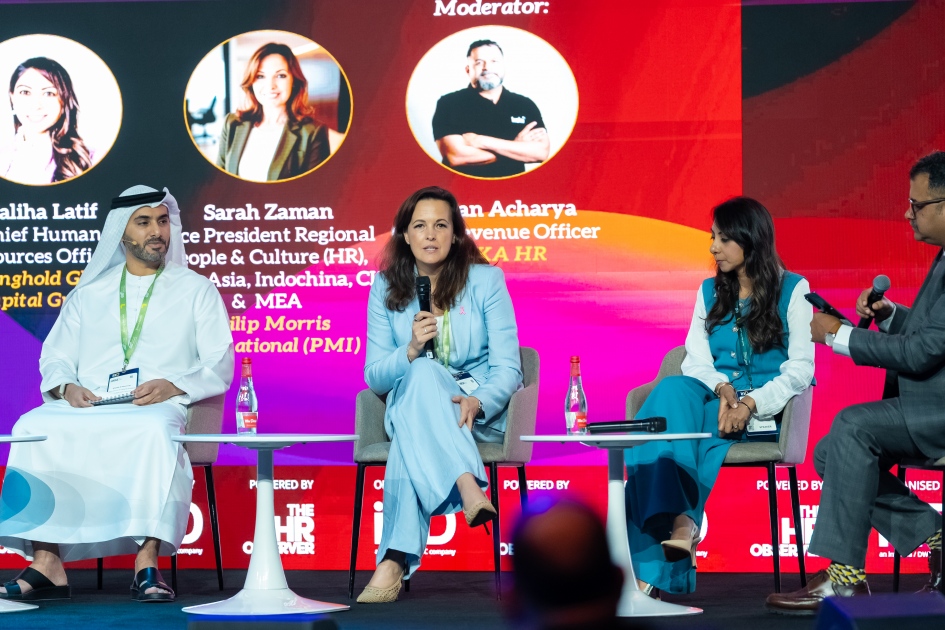
Sarah Zaman, Vice President Regional P&C, South Asia, Indochina, CIS & MEA at Philip Morris International (PMI), believes this requires a different approach to workforce planning.
Speaking at the HR Summit & Expo 2026 in Dubai on the panel From Crisis to Competitive Edge: Strategic Workforce Planning for Uncertain Times, Zaman argued that organisations cannot prepare for uncertainty by trying to predict every change. They need to understand the capabilities they already have, where those can be deployed and what they need to develop next.
“The biggest shift leaders can make is to stop treating uncertainty purely as a forecasting challenge and start treating it as a capability challenge,” Zaman said.
From jobs to capabilities
If a new business requirement emerges, the immediate response may be to create a position and recruit for it. A skills-based approach, Zaman argues, starts with different questions: what work needs to be done, what capabilities does it require and do those skills already exist within the organisation?
Having that visibility can change the decisions that follow. A required skill may already sit in another function or market. An employee may be able to take on a new requirement with targeted development. In other cases, external recruitment may still be necessary.
Zaman highlighted how this is the thinking behind PMI’s Global Jobs & Skills Architecture, which connects jobs and skills across the organisation to provide a clearer view of existing capabilities and emerging requirements. That understanding can then inform decisions around reskilling, development and internal mobility as business needs evolve. The objective is not to eliminate traditional roles or workforce structures, but to understand the capabilities that sit beneath them.
Make talent easier to move
Visibility alone, Zaman emphasised, does not create flexibility. Organisations must also deploy talent when priorities change. For businesses operating across multiple markets, this requires balancing consistency with local adaptability. Some areas benefit from standardisation and scale, and others need to respond to specific market requirements. Workforce models therefore need enough structure to provide clarity without becoming too rigid to adjust.
Talent mobility plays an important role here. Creating opportunities for employees to contribute across projects, functions and markets can give organisations access to capabilities beyond individual teams, while giving employees broader experience and allowing knowledge to move through the business. “When disruption occurs, the ability to mobilise existing capabilities quickly is just as important as bringing in new talent,” Zaman said. “Building this flexibility in advance helps organisations respond with speed and confidence.”
Plan for how work is changing
Technology such as AI and advanced analytics can bring together business, talent, skills and operational data, enabling organisations identify emerging gaps and assess different workforce scenarios. At the same time, AI is changing the work being planned for.
Automation may take on repetitive activities, while employees spend more time on problem-solving, innovation, customer engagement and decision-making. In many cases, this will change the tasks within a role rather than remove it altogether. The skills required to perform it will evolve as a result.
For workforce leaders, this makes headcount alone a less useful measure of readiness. Scenario-based planning can help organisations consider which tasks are likely to change, which capabilities will become more important, where employees can be reskilled and where new expertise may be required.
Technology can support those decisions but should not make them indefinitely. “AI can provide valuable insights, but decisions affecting employees require appropriate governance, human judgement, transparency and accountability,” Zaman said. “It should enhance leadership decision-making, and not replace the human responsibility that comes with it.”
Build the ability to respond
No workforce plan can anticipate every change. The more practical goal is to give an organisation more options when change happens. That starts with knowing which capabilities are critical, where they exist and how easily talent can be developed or moved as priorities evolve. From there, leaders can make clearer decisions about what to build internally, what to redeploy and where additional expertise is needed.
“If you only do one thing, build a clear view of your critical capabilities and the talent that holds them,” Zaman said. “Everything else, including redeployment, reskilling, succession planning, AI adoption and organisational agility, becomes significantly easier when you have that foundation.”


NWC revises water, wastewater tariffs from Jan. 1
Monday 26 October, 2026 8:00
King Salman orders support measures ahead of utility tariff changes
Monday 26 October, 2026 8:00
MOMAH: 7M sqm of white land in Tabuk, Hail, Jazan enter development, trading
Monday 26 October, 2026 8:00
Saudi Arabia to excel in advanced technologies amid robust digital base: Al-Khorayef
Monday 26 October, 2026 8:00